

Product Classification
Deburring and Sanding Machine
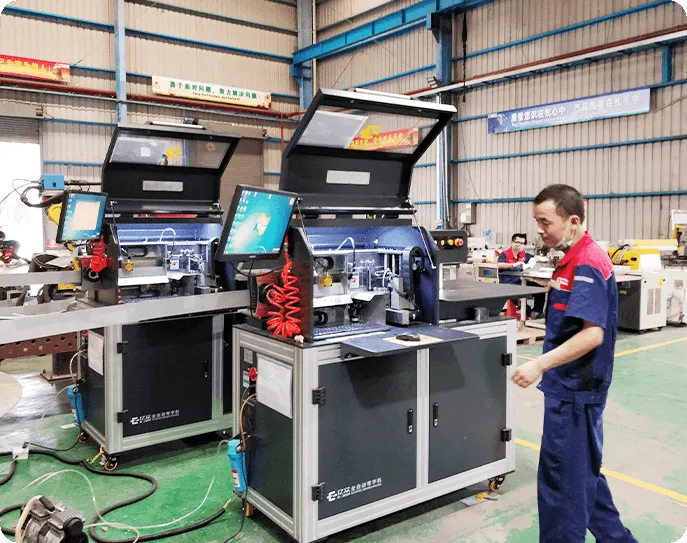
In the advertising sign fabrication industry, most quality issues do not originate from design or cutting accuracy, but from insufficient edge treatment and surface finishing. A Sanding Deburring Machine is not simply an auxiliary device—it functions as a core quality control process between cutting, bending, welding, and final assembly.
For manufacturers producing channel letters, metal sign letters, signboards, and logos, the sanding deburring machine directly determines whether a product is install-ready or becomes a rework risk.
Laser cutting, CNC punching, and plasma cutting inevitably leave micro burrs, sharp edges, and heat-affected zones. These defects may appear minor, but in real projects they often cause:
Poor welding strength
Uneven bending results
Coating adhesion failure
Scratches during transportation
Safety risks during installation
A Sanding Deburring Machine for sign manufacturing eliminates these hidden defects early in the production flow, ensuring downstream processes remain stable and predictable.
Unlike manual grinding, which depends heavily on worker experience, a Sanding Deburring Machine standardizes the finishing process. Each sheet or profile passes through the same abrasive pressure and brushing path, ensuring uniform edge radius and surface consistency.
For factories producing standardized channel letters or batch metal sign letters, this consistency is essential to maintaining stable output quality across large orders.
Different sign materials respond differently to cutting and bending. A multi-functional Sanding Deburring Machine allows manufacturers to fine-tune surface treatment based on material characteristics:
Stainless steel: removes laser slag without damaging surface finish
Aluminum and aluminum profiles: smooths edges while preventing deformation
Galvanized steel: protects zinc coating integrity
Carbon steel: prepares surfaces for painting or powder coating
Copper and brass: maintains decorative texture while removing sharp edges
Using a Sanding Deburring Machine for stainless steel and aluminum signage helps preserve material value while improving final appearance.
In channel letter production, unprocessed burrs often interfere with precise bending and fitting. A Sanding Deburring Machine for channel letters ensures clean edges before bending, allowing side walls to align correctly with faces and backs.
This directly improves:
Bending accuracy
Welding seam quality
Structural strength
Visual symmetry of finished letters
When paired with a Channel Letter Bending Machine, the sanding deburring machine forms a highly efficient and reliable production sequence.
Surface preparation is critical for painting, powder coating, electroplating, or brushing effects. A precision Sanding Deburring Machine creates a uniform micro-texture that improves coating adhesion and reduces peeling or bubbling over time.
For outdoor signboards, logos, and sign boxes, this process significantly extends product lifespan and reduces after-sales issues.
Many sign factories underestimate how much rework originates from poor edge finishing. Manual deburring often leads to inconsistent results, missed sharp corners, or excessive material removal.
A high-efficiency Sanding Deburring Machine minimizes these risks by delivering controlled, repeatable results. This reduces:
Secondary grinding
Material waste
Installation complaints
Project delays
Over time, the sanding deburring machine becomes a cost-control tool rather than an expense.
Custom logos, irregular fonts, and non-standard shapes are increasingly common in branding projects. A flexible Sanding Deburring Machine for custom signage handles complex contours more reliably than manual methods, ensuring every edge meets the same quality standard.
This capability allows sign manufacturers to confidently accept higher-value, design-driven projects.
Whether processing small batches or running continuous production, a Sanding Deburring Machine for advertising sign fabrication industry adapts to different throughput demands. From compact workshop models to industrial-scale systems, it supports long-term growth without compromising quality.
For manufacturers aiming to move from labor-intensive workshops to standardized production lines, the sanding deburring machine is a key transition tool.

In an industry where visual details define brand perception, edge quality is no longer optional. A professional Sanding Deburring Machine ensures that channel letters, metal sign letters, signboards, and logos leave the factory with clean edges, consistent surfaces, and installation-ready safety.
As customers demand higher finishing standards and faster delivery, the Sanding Deburring Machine becomes a decisive factor in maintaining reputation, efficiency, and profitability within the advertising sign fabrication industry.
For more information about Laser And CNC Metal Processing Machines, please contact us!

Stable Development
The team started with four people in 2011 and grew to 110 by 2025, developing steadily and having a long history

Design and R&D Capabilities
4 hardware R&D engineers and 2 software R&D engineers.

After-Sales Service System
A complete after-sales service system, with professional after-sales engineers providing 24-hour remote service and on-site service
R&D Capability
Hardware Team (4 people)
1 circuit designer, 1 embedded developer, 2 mechanical structure developers
Main responsibilities: R&D and testing of mechanical design hardware, establishing a hardware module reuse system, and improving development efficiency by over 30%.
Software Team (2 people)
Using a full-stack development model, we design, maintain, and update the architecture of intelligent equipment control systems.
Collaborative Optimization
Hardware Acceleration Development Team (3 hardware developers + 1 software developer), implementing daily stand-up meetings, biweekly development iterations, and a collaborative debugging lab.
Solution

【Efficiency Revolution】: 500% Efficiency Improvement in Sheet Metal Grinding
Slag Removal: Applicable to slag removal after laser cutting, flame cutting, and plasma cutting. Equipment such as the YZ1000SS and Y1300SS use abrasive belts to grind the workpiece surface, effectively removing slag and achieving a near 100% slag removal rate.