

Share:
Nov. 23, 2026
Whether you are new to sign production or refining an established shop procedure, safer results come from following the same sequence every time: identify the sign material and its hazards, inspect and configure the machine, control access and dust, wear task-appropriate PPE, feed work within the machine’s limits, and verify the finished edges before shutdown and cleanup. In this guide, we share practical Safety Tips for Using Sanding Deburring Machines in Sign Fabrication, including controls for aluminum, stainless steel, acrylic, and other common substrates. Use your Ejon Flying equipment manual and site risk assessment as the final authority for machine-specific settings; the steps below are a working framework, not a substitute for training or required safeguards.
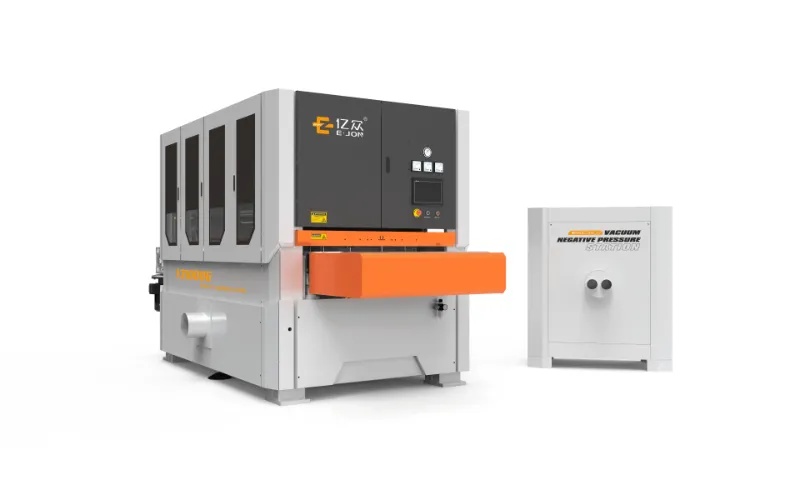
Before switching on a Sanding Deburring Machine, identify the workpiece, coating, and process. A setup suitable for deburring aluminum may not be appropriate for acrylic, painted panels, or stainless steel. Material choice affects abrasive selection, feed rate, heat generation, dust behavior, and the risk of sparks or fire.
Next, review the machine’s risk assessment, operating manual, and emergency-stop locations. OSHA requirements such as 29 CFR 1910.212 for machine guarding and 29 CFR 1910.147 for hazardous-energy control may apply in the United States. ANSI B11.19 provides safeguarding guidance, while ISO 12100 describes machinery risk-assessment principles. Confirm applicable editions and local requirements with your safety lead or authority having jurisdiction.
A short pre-start inspection catches problems before they become injuries or scrap. We recommend a documented checklist at the start of each shift and whenever tooling, material, or machine settings change.
Do not rely on a numeric setting copied from another shop. Machine design, abrasive condition, panel thickness, and material composition all affect the result. If an edge-radius specification is tight, use an appropriate calibrated gauge; a gauge with 0.01 mm resolution does not, by itself, prove the machine can hold 0.01 mm accuracy.
Machine guarding and extraction come first; PPE is an additional layer, not a replacement. Select equipment through your workplace hazard assessment and confirm it does not create an entanglement risk.
After processing, burrs and sheet edges may be sharp. Handle panels with approved lifting aids or cut-resistant handling protection only when the machine is stopped and the task no longer places hands near moving parts.
Dust control is one of the most important Safety Tips for Using Sanding Deburring Machines in Sign Fabrication. Fine particles can irritate or harm workers, contaminate finished graphics, damage equipment, or create a fire and explosion risk depending on the material and collection system.
Never use compressed air to blow dust off clothing, machinery, or the floor unless a specific approved procedure allows it. Use the designated cleaning method and equipment for the collected material.
Once the machine is ready, focus on stable handling. A panel that twists, snags, or enters at an angle can damage the finish and expose the operator to unexpected movement.
For a jam, damaged abrasive, or adjustment inside a guarded area, follow the machine’s shutdown and lockout/tagout procedure. A stop button may not isolate electrical, pneumatic, or stored mechanical energy. Under applicable rules, hazardous energy must be controlled before servicing or clearing a hazard.
After the first test piece, inspect for sharp burrs, rounded corners, chatter marks, scratches, heat discoloration, melted plastic, and coating damage. Compare the edge with the drawing, customer specification, or approved sample. For a critical job, document the abrasive type, machine setting, material batch, operator, and inspection result so the run can be repeated.
Use 100% visual and tactile inspection of the first-off piece, with tactile checks performed only after the machine is stopped and the sample is safely removed. For ongoing production, set a sampling frequency based on risk, job requirements, and process capability. If a contract specifies a recognized quality test, follow that method and its acceptance criteria; do not claim compliance with an ASTM or DIN test unless that exact test is applicable and has actually been performed.
Consider an illustrative, composite example—not a verified customer case. A small sign shop runs aluminum panels and acrylic letters through the same deburring area. Operators notice occasional sharp edges on aluminum and smeared acrylic edges. The shop separates work by material, confirms the extraction setup for each process with the equipment suppliers, adds a first-off inspection sheet, and trains operators to stop rather than reach into a jam. It then records abrasive changes and checks finished edges against the job requirements.
The improvement comes from controlling variables, not from one universal machine setting. If your own defects continue, change one factor at a time and involve the machine or abrasive supplier. Ejon Flying can be included in your equipment support workflow for machine-specific questions; provide the model, substrate, abrasive details, and a clear description of the fault. Confirm any response-time commitment directly with the supplier rather than assuming a service guarantee.
These simple records help turn Safety Tips for Using Sanding Deburring Machines in Sign Fabrication into a repeatable shop routine:
| Tool or record | What to include | When to use it |
|---|---|---|
| Pre-start checklist | Guards, interlocks, abrasive condition, extraction, emergency stop, and housekeeping | At shift start and after a setup change |
| Material and SDS register | Substrate, coating, dust hazards, approved extraction, and handling precautions | Before introducing a new material |
| First-off inspection sheet | Edge condition, dimensions if specified, finish, and operator sign-off | At setup and after process adjustments |
| Maintenance and training log | Service dates, defects, corrective actions, and operator training | Ongoing; review periodically |
The most reliable Safety Tips for Using Sanding Deburring Machines in Sign Fabrication are simple to repeat: identify the material, inspect guarding and extraction, wear task-appropriate PPE, feed panels within machine limits, stop before clearing problems, and verify the finished edge against the job specification. Keep operator training, inspection, and maintenance records, and use qualified safety or fire-protection professionals when dust hazards require specialist assessment. With a documented process and machine-specific guidance from Ejon Flying, sign shops can reduce avoidable exposure, protect finish quality, and make safe operation part of every production run.
Hot Products

Equipped with full servo control system to ensure the accuracy and stability of feeding, slotting, and bending function.

Manipulator alternately feeding structure, the material clamps are casted which can avoid scratching the matenial, mean while improving the feeding holding.

Productive: Cutting, Notching, Flanging, Bending & Shearing. All the functionl will short the letter making time.

Adaptable: can process all kinds of materials used in making sign letters, such as stainless steel, galvanized steel, flat aluminum, profile aluinum and channelume.

EJON Sanding-Deburring Machine-YZ1000G
Application: remove solid slag and burrs on the surface of workpiece; remove rust and oxide layer on the surface of the workpiece; Round the internal and external contours at the edge of metal sheet.

EJON Sanding-Deburring Machine-YZ1000S
Application: remove solid slag and burrs on the surface of workpiece; remove rust and oxide layer on the surface of the workpiece; Round the internal and external contours at the edge of metal sheet.

EJON Sanding-Deburring Machine-YZ1000SS
Supporting laser cutting machine, CNC stamping, various CNC processing or other machining deburring front production line.

EJON Sanding-Deburring Machine
Supporting laser cutting machine, CNC stamping, various CNC processing or other machining deburring front production line.

Industries: metal cutting, electrical switch manufacturing, aerospace, food machinery, textile machinery, engineering machinery, locomotive manufacturing Agriculture and forestry machinery

Laser Welding Machine-300watt/500watt
YAG laser transmission welding, 5 meter fiber optic tube, high temperature resistance handheld laser welding handheld.
